Short answer: Hiking downhill forces your quadriceps to contract eccentrically with every step, which causes far more muscle damage than climbing does. Research shows this specific kind of loading responds to targeted strength preparation — meaning most "my legs were destroyed after that hike" experiences are a training gap, not something to just accept.
Saddleback, Top of the World in Laguna, Aliso and Wood Canyons, Santiago Oaks — Orange County has no shortage of trails with real elevation change. And if you've ever felt your legs shaking on the way down more than the way up, there's a specific physiological reason, and a specific way to train for it.
Why hiking downhill is harder on your legs than climbing
Going uphill, your leg muscles contract concentrically — they shorten as they produce force, powering you up the trail. Going downhill, it's the opposite: your quadriceps have to contract eccentrically, lengthening under load with every step to control your descent and keep you from falling forward. Eccentric contractions are well documented in exercise science as causing more muscle micro-damage than concentric ones, which is the direct physiological reason descents leave hikers far sorer than the climb (Maeo et al., 2017).
What the research on downhill walking actually found
A study specifically examining downhill walking found that prolonged descent reduces leg muscles' force-generating ability and coordination — both of which raise the risk of a stumble or fall later in a hike, when fatigue is highest and the trail often gets more technical. The same research found that a short bout of lower-intensity downhill walking beforehand had a protective effect against damage from a longer, more demanding descent afterward — direct evidence that your legs can be prepared for this specific demand rather than just hoping for the best (Maeo et al., 2017).
Does general strength training reduce hiking injury risk?
While hiking-specific injury research is more limited than running or team-sport research, the broader evidence on strength training and injury prevention is well established. A meta-analysis of 25 randomized trials with over 26,000 participants found strength training reduced overuse injuries by close to half compared to no strength training at all (Lauersen et al., 2014) — a category of injury that closely resembles what builds up over a long, demanding hike: cumulative joint and connective tissue stress rather than a single acute event.
What kind of strength training actually prepares you for a trail?
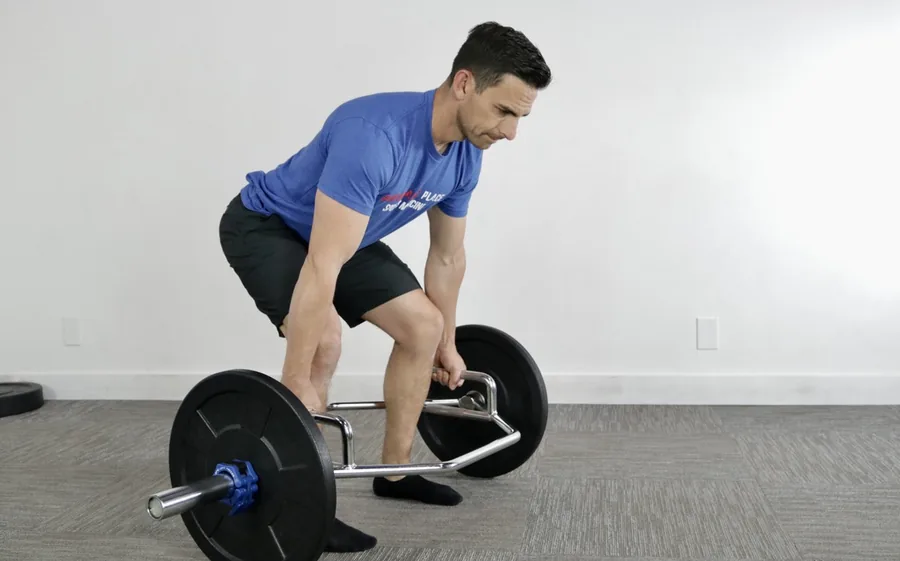
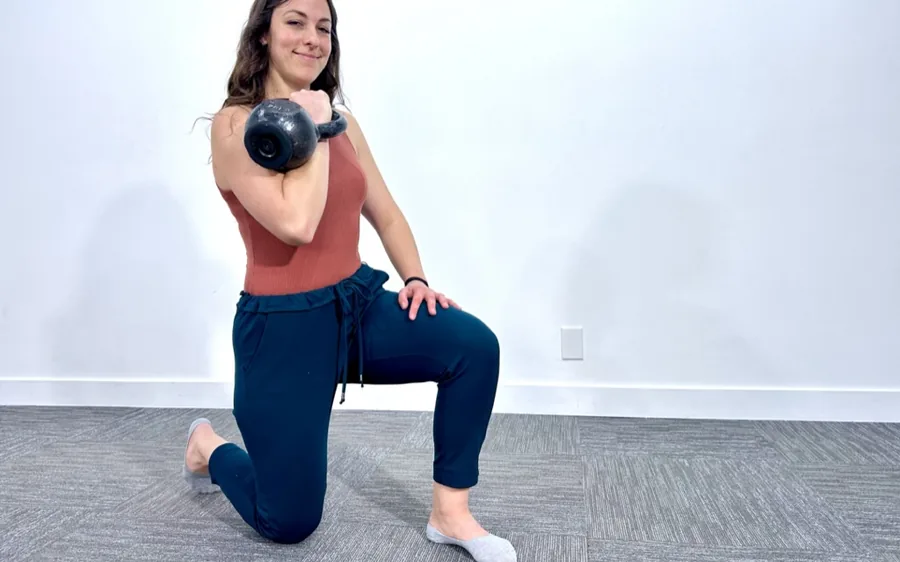
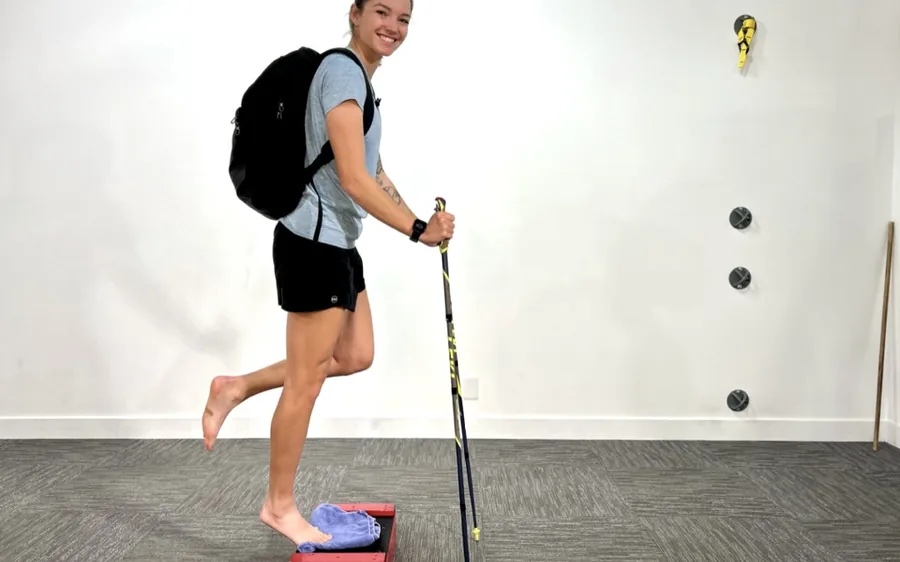
The research points toward single-leg, eccentrically-loaded movements as the most specific preparation: step-downs, split squats, and controlled lunges all train your quadriceps to control your body weight the way a descent demands, rather than just building general leg strength. Pairing that with general lower-body strength (squats, hip hinges) and core stability rounds out preparation for the uneven footing and pack-carrying demands of a real trail.
How far ahead should you start training before a big hike?
Strength and neuromuscular adaptations take real time to develop — a single gym session the week before a demanding hike won't meaningfully change how your legs handle a 3,000-foot descent. Building this kind of leg strength over several weeks, with progressive loading, gives your muscles time to actually adapt before you need them to perform.
If you're training for hikes around Orange County — the Saddleback backbone trail, Top of the World, or a bigger out-of-town trip you're prepping for — we build programs specifically around trail demands: eccentric leg strength, single-leg stability, and the general capacity to carry a loaded pack. Available as in-person 1-on-1 training in Costa Mesa, small group training for a lower cost with the same individualized approach, or online coaching if you're outside the area.
A quick note
This article is educational, not medical advice. Finish Line Personal Training is a strength & conditioning coaching company, not a medical provider — we don't diagnose or treat injuries. If you have a current injury or joint condition, see a doctor or physical therapist first. If you're medically cleared to train, we're glad to build your program around the trails you actually hike.
References
- Maeo, S., Yamamoto, M., Kanehisa, H., & Nosaka, K. (2017). Prevention of downhill walking-induced muscle damage by non-damaging downhill walking. PLOS ONE, 12(3), e0173909.
- Lauersen, J. B., Bertelsen, D. M., & Andersen, L. B. (2014). The effectiveness of exercise interventions to prevent sports injuries: A systematic review and meta-analysis of randomised controlled trials. British Journal of Sports Medicine, 48(11), 871–877.
- Lauersen, J. B., Andersen, T. E., & Andersen, L. B. (2018). Strength training as superior, dose-dependent and safe prevention of acute and overuse sports injuries: A systematic review, qualitative analysis and meta-analysis. British Journal of Sports Medicine, 52(24), 1557–1563.